


If you’re lucky, you might catch a glimpse of a tiny hummingbird among lush green leaves, beating its wings so quickly they’re invisible. Its metallic, multi-colored feathers catch the light as it hovers in front of bright orange and red flowers. Then, as quickly as it appears, it darts away.
The open space at La Selva Biological Station and Reserve in Costa Rica serves as a natural environment among the dense rainforest.
But about two hours away, in the capital of San José, nature collides with streets humming with heavy traffic, tall buildings, and litter. Here, the feathered creatures are using man-made materials where they raise their young.

When Gerardo Avalos saw a hummingbird picking at his clothes drying outside, he knew something was up.
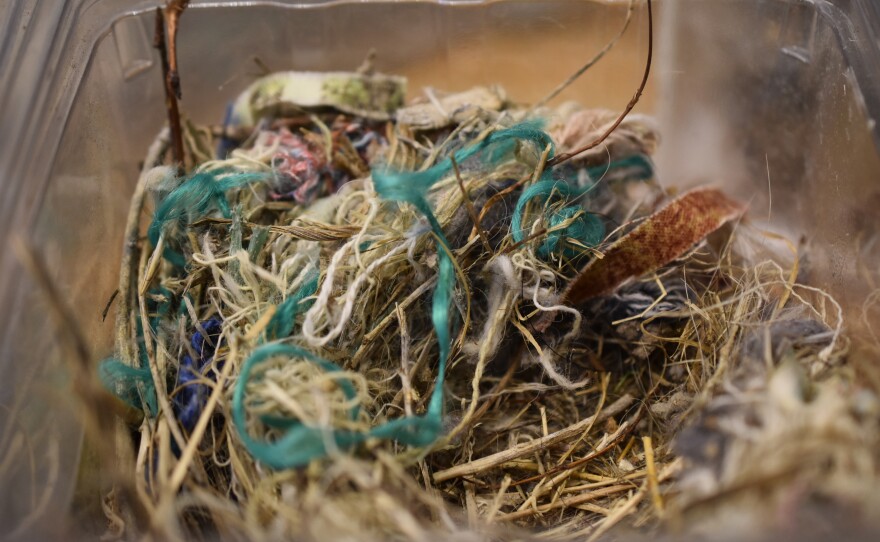
“I was looking at this Rufous-tailed hummingbird stealing threads from hanging laundry. A few weeks later, I found this plastic nest on the ground. It was shaped like a cup. It had also pieces of lichen attached to it, but it was very elastic because the fibers were made of polyester,” Avalos said.

Avalos is a full professor of tropical ecology at the Universidad de Costa Rica and the director of the Center for Ecological Resilience Studies at The School for Field Studies. He later discovered a second nest, the size of a golf ball, at the entrance of a hotel. Threads from plastic bags that once contained rice, beans, or grain hung from it.
“It's a red flag. Animals are adapting to the use of plastic. We are changing the environment. Some birds even use cigarette butts, and for a very good purpose, in the sense that the toxins also deter predators and parasites, but also may have consequences on the birds themselves,” Avalos said.
“Another thing is that they may get overly hot. Plastic usually absorbs a lot of heat, especially during times of climate change that may have consequences on even the sex determination of the chicks, or even their survival rate, but at the same time, in [sic] cold nights, they may provide insulation.”
Artificial materials were identified in nests dating back to the 1830s.
Birds are sentinel species, said Dongming Li, an animal ecologist and professor at Hebei Normal University in Shijiazhuang, China. This means they are sensitive to changes in their habitat and can be early indicators of environmental problems to come.

“Birds have efficient respiratory systems; they need frequent feeding to support their flat and high body temperature. Therefore, changes in food availability and environmental contamination can affect them quickly. They are highly mobile because of powered flight. They are very diverse. Birds occupy nearly all major ecosystems, and are in close contact with air, water, and soil. It indicates that plastics are present (in) oceans, rivers, wetlands, farmland, urban areas, and are accessible to wildlife,” Li said.
More than 4.4 billion pounds of solid waste are generated worldwide each year, and that’s expected to increase more than 50% by 2050.
Northern Nevada is not immune. Alan Gubanich, education committee chair of the Northwest Nevada Bird Alliance and retired biology and ornithology professor at the University of Nevada, Reno, covers his kitchen counter in nests he’s collected mostly from the Bullock’s Oriole. The flame-orange and black bird migrates from the tropics to Western North America to lay its eggs. Their shopping-bag-shaped nests contain baling twine and cloth, and one is engulfed in shiny green tinsel.




In English, the term “bird brain” is used as an insult to call someone stupid. A similar idiom exists in Spanish, “cabeza de chorlito,” which translates to “plover head.” If someone calls you this, take it as a compliment,” Gubanich said.
“Thank you, because so many studies recently have shown how intelligent birds really are,” Gubanich said. “It doesn't surprise me that, ‘Okay, if I'm running out of grass in this area, and I got to build a nest, well, look at all this long stuff. Why not use it?’ If they weren’t adaptable, they’d all died out by now, after all these millions of years, with all the changes that have taken place in the world. This is one way to survive. Use this plastic Easter basket grass.”
However, it could be an ecological trap.
The Urban Bird Project at the University of Texas at San Antonio installed about 140 nest boxes and found that 86% contained some form of plastic. Some culprits were H-E-B tortilla wrappers, dental floss, and candy wrappers.


Jennifer Smith, the C. C. (Charlie) Winn endowed chair for Quail Research at the Caesar Kleberg Wildlife Research Institute at Texas A&M University-Kingsville and assistant professor of quail ecology and management, served as a co-principal investigator.
A large number of birds are ingesting plastic, Smith said.

“The pathways of exposure, we can guess what they are, and one could be accidental consumption from nests,” Smith said. “Then there’s all kinds of different effects that could have, both physically, so obstructing the gastrointestinal (GI) tract, but also chemicals that are associated with plastics, such as those which are incorporated when they're made, but also chemicals from the environment that can absorb onto plastics.”
Smith said those chemicals can disrupt hormone systems, which are important for bird behaviors, sleep patterns, and reproduction.
Plastic materials can also alter nest temperature, humidity, ventilation, or drainage, Li said.
“This change can affect incubation in embryo development, chick growth, or survival,” Li said.
And it gets worse, said Mariel Ortega, graduate research assistant at the University of Texas at San Antonio, who studied unhatched eggs from the nest boxes.
“There was one egg that had about 14 microplastics in it. It indicates potentially that there is maternal transfer from within the mother bird's body. It seems from the very first developmental stage, birds are being exposed to microplastics," Ortega said.
Out of the 19 unhatched eggs Ortega collected, more than a quarter contained microplastics. She said one simple solution could be to consider how often trash is collected.
Microplastics are a new area of research, with much to be discovered, but one thing is certain: human behavior needs to change drastically, Smith said.

“I’m a consumer too. We’re all sat here with [a] plastic lid to a coffee cup, probably plastic in the hat I’m wearing. No one’s not guilty of consuming plastic, but it’s what is available, and in some cases, plastic items are cheaper than alternatives,” Smith said.
The plastic problem isn’t going away any time soon. Avalos has mixed feelings about how opportunistic birds are.
“I don’t know what to do: Either admire the hummingbirds for their high capacity of adaptation or start crying because of the impact that humans have on the environment,” Avalos said.
This story was produced in partnership with the Hitchcock Project for Visualizing Science and the Reynolds School of Journalism.
